
Technical Resources
What Is A Lifting Beam
Engineering guides, technical information and lifting beam knowledge from Carl Stahl Fabrication.
Looking for a bespoke lifting beam instead?
View our Bespoke Lifting Beam Manufacturing Service →
Understanding Lifting Beams
A lifting beam is a below-the-hook lifting device designed to lift loads safely using multiple attachment points. By distributing forces across the load, lifting beams improve stability, reduce stress concentrations and help operators lift awkward or heavy components safely.
Lifting beams are commonly used throughout manufacturing, construction, energy, infrastructure and steel fabrication industries where controlled and reliable lifting is critical.
Unlike traditional lifting methods, lifting beams can be engineered to suit specific load dimensions, lifting points and operational requirements.
How Does a Lifting Beam Work?
A lifting beam is attached to a crane hook via a central lifting point. The load is then connected to the beam using slings, shackles, hooks or other lifting accessories positioned along the beam.
This arrangement distributes the load more evenly and helps maintain balance during lifting operations.
- Distributes load evenly
- Improves load stability
- Reduces stress on the load
- Allows multiple lifting points
- Supports bespoke lifting arrangements
Key Features Of A Lifting Beam
Safe Load Distribution
Lifting beams spread loads across multiple lifting points, reducing stress concentrations and improving overall lifting stability.
Custom Engineered
Every lifting beam can be designed around specific load dimensions, lifting points and operational requirements.
Versatile Applications
Suitable for manufacturing, construction, infrastructure, energy and heavy engineering lifting operations.
Built To Standards
Manufactured, tested and certified to relevant lifting equipment standards for safe operation and compliance.
Common Applications Of Lifting Beams
Lifting beams are used across a wide range of industries where loads need to be lifted safely, evenly and with greater control. Their versatility allows them to be engineered for everything from manufacturing facilities to major infrastructure projects.
Manufacturing
Lifting beams are widely used in manufacturing facilities to safely lift machinery, fabricated components and production equipment while maintaining load stability.
Construction
Lifting beams are widely used within the construction industry for handling structural steelwork, precast concrete sections, plant equipment and other large building components safely and efficiently on site.
Energy
The energy sector uses lifting beams for moving transformers, generators, pressure vessels, pipework and other critical equipment during maintenance, installation and shutdown projects.
Infrastructure
Lifting beams are commonly used on infrastructure projects for handling bridge sections, precast concrete units, structural steelwork and other oversized components where safe and controlled lifting is essential.
Steel Fabrication
Steel fabricators use lifting beams to move fabricated assemblies, welded structures and heavy steel components throughout manufacturing, testing and installation processes while maintaining load stability.
Heavy Engineering
Heavy engineering industries rely on lifting beams for handling large machinery, process equipment and specialist components that require precise load distribution and dependable lifting performance.
Types Of Lifting Beams
Lifting beams are available in a range of configurations to suit different load shapes, weights and lifting requirements. The most suitable design depends on factors such as load dimensions, available headroom, lifting points and the working environment.
Central Point Lifting Beams
Fixed lifting beams feature predetermined lifting points and dimensions, making them ideal for repetitive lifting operations where the load characteristics remain consistent. They offer a simple, robust and cost-effective solution for routine lifting tasks.
Adjustable Lifting Beams
Adjustable lifting beams allow lifting points to be repositioned along the beam, providing greater flexibility for handling loads of varying sizes and centres of gravity. They are commonly used where multiple load types need to be lifted using a single beam.
Modular Lifting Beams
Modular lifting beams consist of interchangeable components that can be assembled into different configurations. This versatility makes them suitable for projects requiring a range of lifting capacities and load dimensions while reducing the need for multiple dedicated lifting devices.
Telescopic Lifting Beams
Telescopic lifting beams incorporate extendable sections that allow the beam length to be adjusted as required. They are particularly useful when lifting loads with changing dimensions or where storage space is limited.
Bespoke Lifting Beams
Bespoke lifting beams are engineered to meet specific operational requirements, including unique load shapes, restricted headroom, multiple lifting points or specialist industry standards. Custom designs ensure safe and efficient lifting performance for complex applications.
Spreader Beams
Although often grouped alongside lifting beams, spreader beams use angled slings to transfer compressive forces through the beam while reducing load stress and increasing lifting stability. They are commonly used for long, flexible or delicate loads.

On This Page
Need a Bespoke Lifting Solution?
Talk to our engineers about a custom lifting beam, spreader beam or lifting frame designed specifically for your load, environment and lifting requirements.
From adjustable lifting beams to heavy-duty fixed lifting beams, our engineering team designs and manufactures bespoke lifting solutions for a wide range of industrial applications.
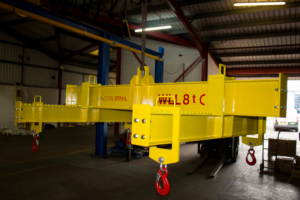
Adjustable lifting beam | Manufacturing
Designed and manufactured for a customer requiring flexible load handling capabilities, this bespoke adjustable lifting beam features repositionable lifting points to accommodate varying load centres and operational requirements. Supplied complete with proof load testing and certification to relevant standards.
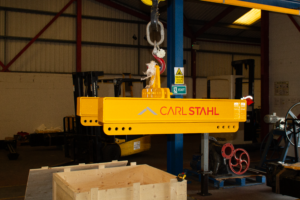
H-frame lifting beam | Industrial handling
This bespoke H-lifting beam was engineered to provide stable and controlled load handling across a range of industrial lifting applications. The adjustable configuration enables operators to modify lifting positions to suit changing load dimensions and centre-of-gravity requirements.

Fixed lifting beam | Heavy engineering
Designed for a heavy-duty industrial application, this bespoke 24-tonne lifting beam was manufactured in a four-point lifting configuration. Our engineering team carried out full design verification and produced a compliant lifting solution tailored to the customer’s operational requirements.
Explore Our Other Resources

Understand the key differences between lifting beams and spreader beams, including how they distribute loads, typical applications and when each solution is most suitable for safe lifting operations.

Explore the most common lifting equipment design mistakes, from poor load assessment and incorrect lifting points to inadequate consideration of operating environments and safety factors.

Learn what proof load testing is, why it is required and how it verifies the safety, performance and compliance of lifting equipment before it enters service.